Learning objectives
Aircraft icing is a major aviation hazard because relatively small deposits of ice can change the shape and performance of critical aircraft surfaces.
- Explain supercooling and the formation of ice from liquid droplets below 0°C.
- Identify the atmospheric conditions that favour airframe icing.
- Distinguish rime, clear/glaze and mixed ice by formation and appearance.
- Explain the special risks associated with supercooled large droplets and freezing precipitation.
- Describe how ice affects lift, drag, stall speed, weight, balance and aircraft systems.
- Recognize frost, snow accretion, cold-soaked wing icing and engine icing.
- Differentiate anti-icing from de-icing and describe common protection systems.
- Interpret icing intensity reports and understand the importance of aircraft-specific limitations.
- Apply icing information to flight planning, dispatch, diversion and pilot reporting.
What is aircraft icing?
Aircraft icing is the accumulation of ice on an aircraft or within its systems. It may occur in flight, while parked on the ground, or during taxi, take-off and landing. In-flight airframe icing most commonly occurs when supercooled liquid water droplets strike a surface whose temperature is below freezing and then freeze.
Icing is cumulative: as ice builds up, the aerodynamic and mechanical effects can become progressively more serious. The rate of accumulation depends on the atmospheric environment and the aircraft itself. Aircraft design, speed, surface temperature, wing geometry, droplet size, liquid-water content and the effectiveness of ice-protection equipment all influence the outcome.
Ice on wings, tailplanes, propellers, antennas, sensors, windshields and other external surfaces.
Ice in carburettors, engine intakes, inlet guide vanes or other parts of the induction system.
Frost, snow, freezing precipitation or ice contamination while the aircraft is parked or operating on the ground.
The central lesson is that ice is not simply extra weight. It can change the aerodynamic shape of a wing or tailplane, disturb airflow, obstruct sensors and interfere with moving components. A thin rough deposit in a critical location can be more damaging than its mass alone would suggest.
Supercooled water and the freezing process
What is supercooled water?
Clouds may therefore contain supercooled liquid droplets at sub-zero temperatures. When these droplets collide with a cold aircraft surface, they may freeze and release latent heat. The way the droplet freezes determines the nature and shape of the ice accretion.
How droplets freeze on an aircraft

Temperature is only one part of the problem
The quantity of supercooled liquid water in a cloud, the size distribution of droplets, exposure time and airflow all influence accretion. Two aircraft at the same outside-air temperature can experience different icing rates if they encounter different cloud water contents or fly at different speeds and configurations.
Conditions that favour aircraft icing
Temperature range
Airframe icing is commonly associated with sub-zero temperatures in cloud or precipitation containing liquid water. A broad range of temperatures can support icing. The most hazardous temperature level cannot be identified from a single universal number because droplet size, liquid-water content, cloud dynamics and aircraft surface temperature matter as well.
In many ordinary cloud situations, supercooled liquid water is particularly relevant in the layer from around 0°C down to approximately −20°C. At colder temperatures, a greater proportion of cloud water may be frozen into ice crystals, but strong vertical currents can transport liquid droplets to colder levels. Never interpret a temperature threshold as a guarantee of safety.

Cloud types and icing potential
| Cloud / weather | Potential icing environment | Operational consideration |
|---|---|---|
| Stratus / stratocumulus | Shallow or extensive supercooled liquid layers may occur | Persistent exposure can lead to accumulation, especially in stable cloud layers. |
| Altostratus / nimbostratus | Layered cloud with liquid droplets and ice crystals; precipitation may be present | Widespread icing layers may extend over large route areas. |
| Altocumulus | May contain supercooled droplets; castellanus can indicate instability | Assess vertical extent, temperature and forecast icing data. |
| Cumulus / towering cumulus | Updraughts can maintain liquid water and create changing icing conditions | Rapidly changing conditions and turbulence may accompany icing. |
| Cumulonimbus | Strong vertical currents, supercooled water, ice particles and hail | Thunderstorm avoidance is required; icing is only one of several severe hazards. |
| Freezing rain / drizzle | Supercooled precipitation, potentially including large droplets | Can produce rapid, extensive accretion and severe conditions. |
This course: typical icing associations by cloud type
| Cloud genus / group | study association | Reasoning emphasized in the text |
|---|---|---|
| Cumulus (Cu) / Cumulonimbus (Cb) | Moderate to severe | Strong upcurrents in heap clouds support a high concentration of supercooled droplets; larger droplets may occur in the general 0°C to −20°C range. |
| Nimbostratus (Ns) | Moderate to severe | Extensive precipitation cloud can contain large supercooled droplets in suitable temperature layers. |
| Stratocumulus (Sc) | Light to moderate; potentially severe in mountainous areas | Orographic uplift can support larger droplets and increase the icing hazard. |
| Altocumulus (Ac), Altostratus (As), Stratus (St) | Light | Layer-cloud droplet populations are generally smaller in the model. |
| Cirrus (Ci), Cirrostratus (Cs), Cirrocumulus (Cc) | Nil or trace | These high clouds are predominantly ice-crystal clouds in the simplified syllabus treatment. |
Liquid-water content and droplet size
Small droplets often freeze rapidly on impact and favour rime-like accretion. Larger droplets may spread over the surface or run aft before freezing, favouring clear/glaze ice and potentially creating ice behind protected leading-edge areas.
Freezing level and the vertical profile
The freezing level is the altitude at which the environmental temperature is 0°C. It is useful for identifying layers where icing may be possible, but it is not an icing boundary. Supercooled liquid water may exist above the freezing level, and cold-soaked aircraft surfaces can experience icing in some above-zero ambient conditions.
Factors affecting the severity of icing
This course emphasizes that icing severity is not determined by temperature alone. The size and concentration of supercooled droplets, cloud structure, aircraft shape and speed, and the temperature near the cloud base all influence the amount and type of ice that may accrete.
1. Size of supercooled droplets
Large droplets are more likely to produce clear ice because they may not freeze completely at impact and can flow back over the surface. The text associates larger droplets and moderate/heavy clear icing particularly with Cu, Cb and Ns in the general temperature range from 0°C to −20°C. In layer clouds, smaller droplets are more commonly associated with rime icing. At colder temperatures the droplets generally become smaller; the text describes very small droplets and usually negligible icing at −40°C and below.
2. Concentration of droplets and vertical currents
Heap clouds can contain stronger upcurrents than layered clouds. These currents can support a higher concentration of supercooled droplets, which helps explain why the material associates Cu and Cb with moderate-to-severe icing potential. The text also notes that droplet concentration tends to be greater near the cloud base, where the temperature is warmer and condensation begins.
3. Aircraft shape and speed
The discussion notes that thin shapes collect ice more rapidly than thicker, higher-drag shapes. Thin wings, pressure heads, tailplane surfaces, undercarriage struts and aerials may therefore accrete ice quickly. A small amount of visible ice on the main wing does not prove that other, thinner components are equally lightly contaminated. Higher speed can increase the number of droplets encountered per unit time, although kinetic heating can offset some of the effect.
4. Cloud-base temperature
In the explanation, a warmer cloud base is associated with greater water-vapour content and a greater amount of free water available in the cloud. The concentration of droplets and potential icing severity can therefore increase as cloud-base temperature rises, all else being equal.
5. Exposure time and aircraft capability
Longer exposure allows accretion to build. The same atmospheric conditions can produce different effects on different aircraft because their shapes, speeds, surface temperatures, protection coverage and operating limitations differ.
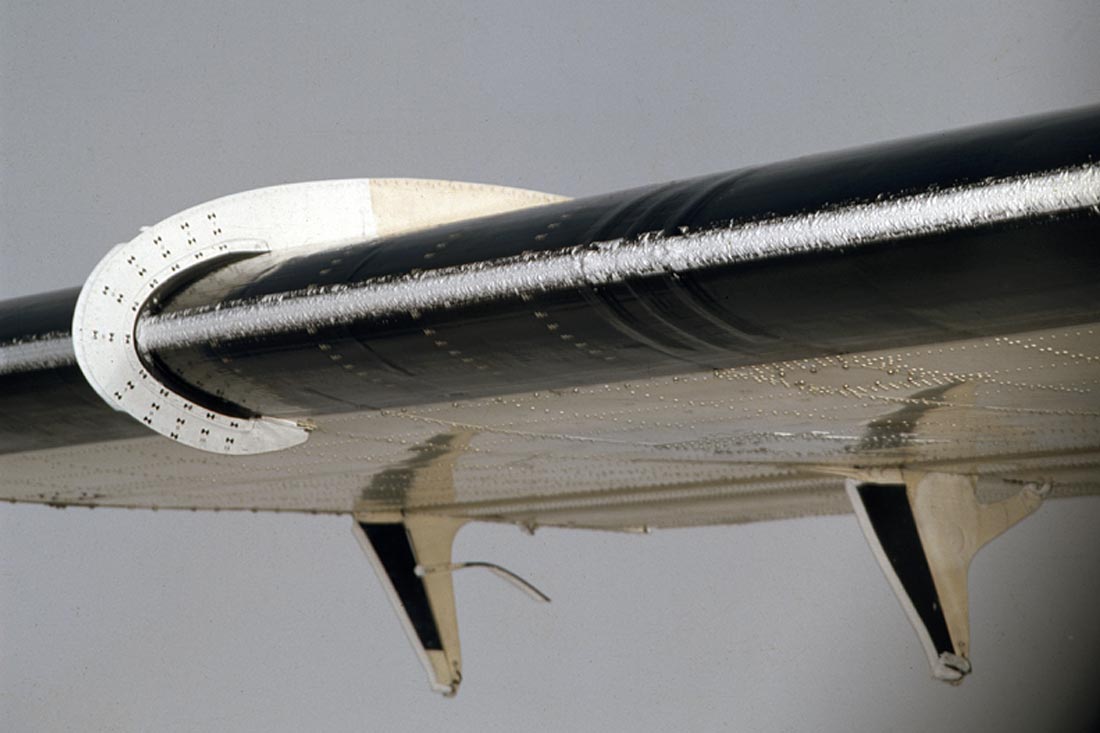
The principal types of airframe ice
Rapid freezing of small droplets; white, rough, opaque and porous.
Slower freezing of larger droplets; smoother, denser and often translucent.
Combination of rime-like and clear-ice characteristics.
Rime icing
Rime ice forms when relatively small supercooled droplets strike a sub-zero aircraft surface and freeze rapidly. The rapid freezing traps small air pockets within the deposit. The resulting ice is generally white or milky, opaque, rough, granular and comparatively brittle.
Typical formation conditions
- Small supercooled droplets.
- Relatively cold conditions and/or lower liquid-water content compared with many clear-ice situations.
- Rapid heat transfer away from the freezing droplet.
- Repeated droplet impacts on exposed leading edges and other forward-facing surfaces.
Appearance and shape
Rime often forms near the stagnation region of a wing or other leading edge. It may build into a rough, irregular or wedge-like shape. Although it may appear less dense than clear ice, its roughness and change to the airfoil contour can seriously disturb airflow.
Aviation significance
Rime ice can disrupt the smooth airflow over the wing, reduce maximum lift, increase drag and raise stall speed. It can also accumulate on antennas, probes, propellers and engine inlets. Its opaque appearance may make it easier to notice than clear ice, but visual detection is not a reliable protection method.
Clear icing
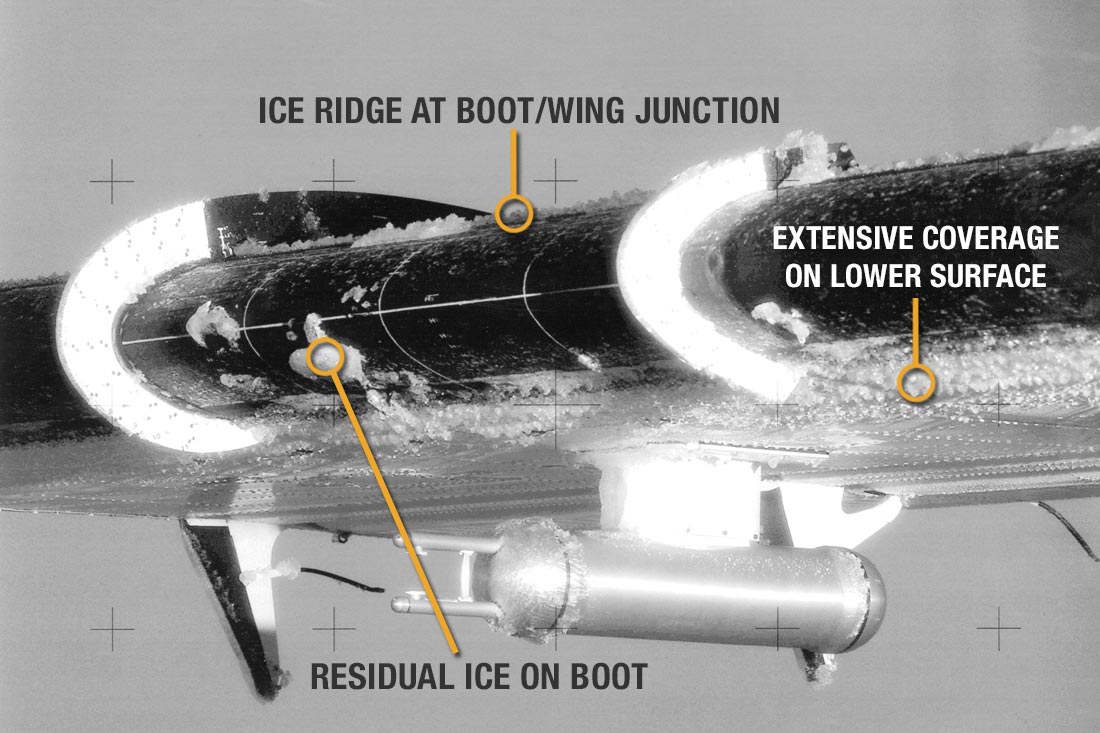
Clear ice, also called glaze ice, forms when larger supercooled droplets strike the aircraft but do not freeze completely and immediately. Some liquid water spreads over the surface or flows aft before freezing. The resulting ice is often smooth, dense, hard, transparent or translucent and strongly adherent.
Why it forms
- Relatively large supercooled droplets.
- Conditions that allow droplets to remain liquid briefly after impact.
- Higher liquid-water content in some cloud environments.
- Water running back before it freezes, creating accretion beyond the initial impact region.
When a supercooled droplet begins to freeze, latent heat is released. This temporarily slows the freezing process. The remaining liquid can spread or flow aft before it solidifies, leaving a clear, dense deposit with little trapped air. This is the physical explanation behind the description of flowback icing.
The text includes a simplified teaching relationship for the fraction of a droplet that freezes on impact as temperature falls below 0°C. Treat that relationship as a syllabus calculation aid, not as a universal prediction of real aircraft ice accretion; actual freezing is affected by droplet size, heat transfer, airflow and surface conditions.
Horns and aerodynamic disruption
Clear-ice accretion may develop protruding ridges or horns near the leading edge. These shapes can cause major airflow separation and performance degradation. Ice may also form aft of protected leading-edge areas when large droplets run back or splash beyond the area covered by ice-protection equipment.
Why clear ice is particularly dangerous
Clear ice can be difficult to see because it may blend with the aircraft surface. It can be heavy, strongly attached and difficult to remove. Its irregular shape can alter the airfoil profile and produce substantial drag and lift penalties. It may extend beyond the area protected by conventional boots or thermal systems, depending on aircraft certification and the droplet environment.
Mixed icing, SLD and freezing precipitation
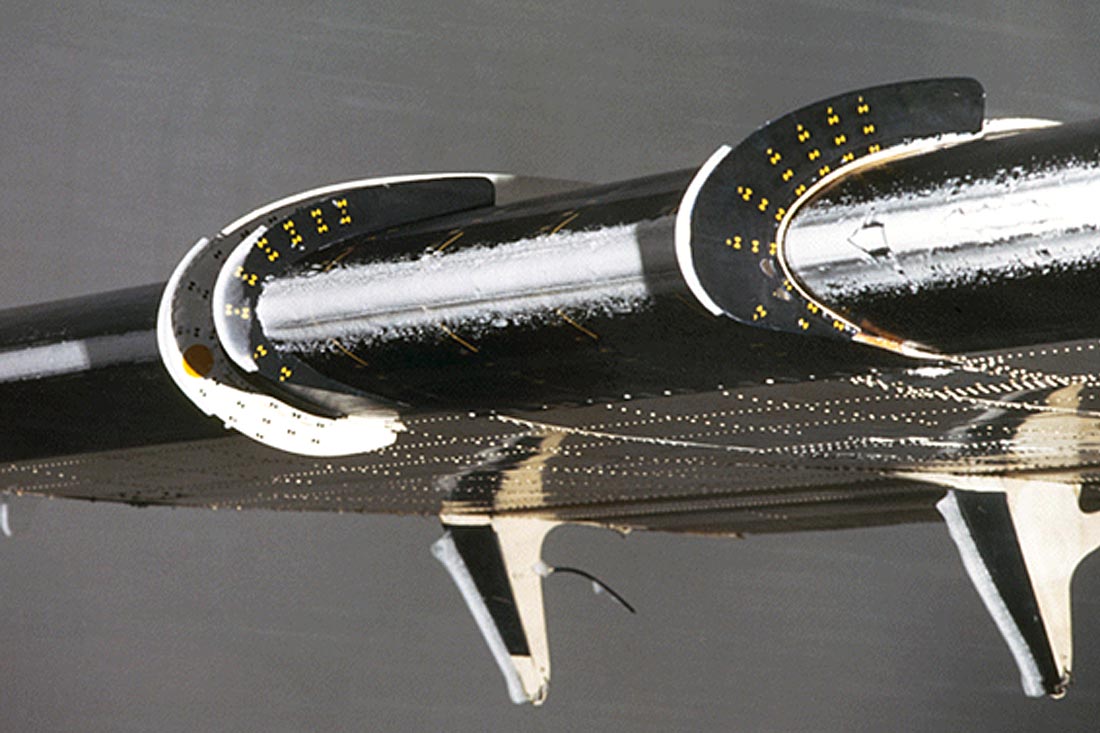
Mixed ice
Mixed ice combines characteristics of rime and clear ice. It may contain opaque, rough areas alongside smoother, translucent areas. It can develop where droplet size and freezing conditions vary, or where different accretion processes occur together. Mixed ice can produce complex shapes that are difficult to assess visually.
Supercooled large droplets (SLD)
Supercooled large droplets are droplets larger than the small cloud droplets normally assumed in many icing models. They include freezing drizzle and freezing rain drops. Because of their size and momentum, they can strike the aircraft and spread or splash beyond the normal impingement area. Water can run aft and freeze on unprotected surfaces.
SLD is especially concerning because conventional ice-protection coverage may not protect all surfaces on which large droplets can accrete. The actual capability depends on the aircraft's certification and system design. Do not assume that installed boots or heaters make an aircraft safe in every SLD condition.
Freezing drizzle and freezing rain
Small precipitation drops that are supercooled and freeze on contact. It may occur beneath cloud layers and can create significant accretion.
Larger supercooled raindrops that freeze on impact. It can cause rapid and extensive ice accretion and is a serious hazard.
Freezing precipitation may be associated with warm-frontal structures and temperature inversions, where precipitation formed aloft falls through a sub-zero layer near the surface. The exact vertical temperature profile determines whether precipitation reaches the surface as freezing rain, ice pellets or another type.
Effects of icing on aircraft
Ice changes the aircraft's aerodynamic and mechanical characteristics. It is dangerous because it can affect several performance variables at the same time.
1. Reduction in lift
Ice roughens the wing surface and changes the designed aerofoil shape. The boundary layer may separate earlier, reducing the maximum lift coefficient. The aircraft may therefore be unable to produce its normal lift at a given speed and angle of attack.
2. Increase in drag
Surface roughness and protruding ice shapes increase resistance. More thrust or power may be required to maintain speed and altitude. If available power is insufficient, climb performance and cruise efficiency deteriorate.
3. Increase in stall speed
When maximum lift is reduced, the aircraft must fly faster to generate the lift required to support its weight. Stall speed can increase, sometimes substantially. The aircraft may also stall at a different angle of attack or exhibit changed stall behaviour.
4. Increased weight and uneven loading
Accumulated ice adds mass. Uneven accretion can also create asymmetry, vibration or imbalance, particularly on propellers and rotor systems.
5. Tailplane icing
Ice can accumulate on the horizontal stabilizer and elevator. Tailplane icing can reduce tailplane lift and may contribute to an abrupt loss of control authority or a tailplane stall, particularly during flap extension on some aircraft types. Symptoms and recovery actions are aircraft-specific; use the approved checklist and training guidance.
6. Systems and sensor interference
- Blocked pitot tubes or static ports can cause unreliable airspeed, altitude or vertical-speed indications.
- Ice can obstruct engine inlets and reduce airflow.
- Ice can affect control surfaces, hinges, gaps, landing gear doors and other moving parts.
- Ice on windshields can reduce visibility.
- Ice on antennas can affect communication or navigation performance.
- Propeller ice can cause vibration, thrust loss and mechanical stress.
| Aircraft characteristic | Possible icing effect |
|---|---|
| Lift | Reduced maximum lift and altered stall behaviour |
| Drag | Increased drag and higher power requirement |
| Stall speed | May increase |
| Weight / balance | Additional mass and possible asymmetry |
| Propulsion | Inlet restriction, propeller imbalance or engine icing |
| Instruments | Blocked or disturbed pressure sensors |
| Control | Reduced effectiveness or restricted movement |
Frost, snow, freezing fog and cold-soaked wings
Hoar frost
Hoar frost is a white crystalline deposit formed when water vapour changes directly into ice on an airframe whose surface is below 0°C. In the description, the vapour is converted directly into ice crystals by deposition, without first becoming liquid water. It can form in clear air; visible cloud is not required.
This course identifies two important situations: (1) on the ground, often overnight, when a cold aircraft surface is exposed to moist air; and (2) in flight, when an aircraft descends rapidly from a very cold region into a warmer, moist layer, or climbs from sub-zero air through an inversion. The source describes the in-flight deposit as generally not severe, but ground frost must be removed before take-off because it increases skin friction, can obscure windscreens and may affect aerials.
Rain ice (supercooled rain)
This course describes rain ice as rain that becomes supercooled after falling from a warmer layer through an inversion into air below 0°C. The drops do not necessarily freeze while falling; they can remain liquid until they strike the aircraft and then accrete as clear or rime ice. The example places this hazard in a relatively narrow low-level band, often ahead of a warm front or occlusion, and associates it with moderate continuous precipitation from nimbostratus.
Pack snow
Pack snow is described in this course as an icing deposit produced by a mixture of supercooled water droplets and snow. It may obstruct air intakes and other aircraft openings. The source describes its effects as normally slight, but blockage of a critical opening can still have operational consequences. Do not confuse pack snow with ordinary loose snow contamination on a parked aircraft.
Aircraft snow contamination
Snow may accumulate on wings, fuselage, tail surfaces and control gaps. Wet snow can adhere strongly and compact; loose snow may also be blown into openings. Snow and ice contamination must be removed in accordance with approved ground de-icing procedures before take-off.
Freezing fog
Freezing fog contains supercooled droplets that can freeze on contact with cold aircraft surfaces. It can produce frost or rime-like deposits on parked aircraft and can create poor visibility at the aerodrome.
Cold-soaked wing icing
Fuel in wing tanks can become very cold during high-altitude flight. After descent into warmer, moist air, the wing skin around the fuel tanks may remain below 0°C. Moisture from rain, drizzle or humid air can freeze on contact with the cold skin even when the outside-air temperature is above freezing. This is known as cold-soaked wing icing.
Engine and induction-system icing
Engine icing is separate from structural airframe icing. Ice may form inside the engine induction system, carburettor, air intake or on components exposed to moist air. The mechanism and risk vary with engine type.
Three piston-engine induction icing mechanisms in the treatment
| Mechanism | How it forms | Potential effect |
|---|---|---|
| Impact icing | Snow, mixed snow/rain or supercooled droplets enter and freeze in intake areas. | Restriction or blockage of induction openings. |
| Fuel icing | Water present in the fuel freezes at bends or restrictions in fuel/induction-related piping as described in the course text. | Restricted flow and possible engine malfunction. |
| Carburettor icing | Cooling from fuel evaporation and pressure/temperature reduction through the venturi. | Ice on the venturi or throttle plate restricts airflow and reduces power. |
Carburettor icing
In a carburetted piston engine, air accelerates through the carburettor venturi. The associated pressure reduction cools the air. Fuel vaporisation also absorbs heat. If the temperature falls below freezing and sufficient moisture is present, ice can form on the venturi and throttle plate, restricting airflow.
Carburettor icing can occur at outside-air temperatures above 0°C, especially in humid conditions. It may occur in cloud, rain, mist or even apparently clear air when humidity is high. A common indication in a fixed-pitch propeller aircraft is a gradual reduction in RPM. In a constant-speed propeller aircraft, manifold pressure may decrease while the propeller governor maintains RPM for a period.
Fuel-injected piston engines
Fuel-injected engines are generally less susceptible to carburettor-venturi icing, but they are not immune to induction-system icing. Ice, snow or other contamination may obstruct an air filter or intake, and alternate air provisions may be installed. Follow the aircraft-specific instructions.
Turbine-engine icing
Ice may form on engine intake lips and inlet guide vanes. If it breaks away and enters the engine, it can damage compressor blades or disturb the airflow. The text highlights that icing may develop in early inlet stages, particularly during approach when engine speed is high relative to aircraft forward speed and local expansion/cooling can occur. Precipitation combined with freezing or near-freezing conditions is an important cue in the discussion.
Ice on engine inlet pressure probes can also make engine power indications unreliable. The text notes the use of engine igniters in potential icing conditions for the aircraft types covered by its guidance; this too must be applied only through the aircraft's approved procedure.
Propeller icing
Ice on propeller blades changes their aerodynamic profile and creates imbalance. It can reduce thrust, increase vibration and impose additional loads. Propeller de-icing may use electrical heating elements or fluid systems, depending on aircraft design.
Anti-icing and de-icing systems
Aircraft use different systems to prevent ice from forming or to remove ice after it has accumulated. The distinction is important.
Prevents or delays the formation of ice on a protected surface. Examples include thermal heating and some fluid-based systems.
Removes ice after it has formed. Examples include pneumatic boots and some electrical or fluid systems.
1. Pneumatic de-icing boots
Inflatable rubber boots are installed along protected leading edges. When activated, they expand and crack the accumulated ice so that airflow can remove it. The timing and operation of boots are aircraft-specific; follow the flight manual rather than applying a generic rule about when to activate them.
2. Thermal anti-icing
Hot engine bleed air may be routed through protected leading edges, engine inlets or other surfaces. The heat prevents or limits ice formation. Some aircraft use electrical heating for selected components and surfaces.
3. Electrical heating
Electrical heaters may protect pitot probes, static ports, angle-of-attack sensors, windshields, propeller blades and other critical equipment. These systems prevent sensor blockage and maintain visibility or component function.
4. Fluid-based systems
Some aircraft use anti-icing fluid delivered through porous panels or distributed over selected surfaces. The fluid lowers the freezing point of water or helps prevent adhesion. System limitations and fluid supply must be considered.
5. Ground de-icing and anti-icing fluids
Ground de-icing removes frost, snow and ice contamination. Anti-icing treatment provides temporary protection against further contamination before take-off. The fluid type, concentration, temperature, application method and holdover-time guidance must be selected under approved procedures.
Light, moderate and severe icing
Icing intensity describes the operational effect and accumulation rate, not merely the visual thickness or colour of ice. Definitions and reporting conventions vary by authority and product. The following descriptions are a study guide; use the definitions applicable to the flight and aircraft.
| Intensity | General interpretation | Operational meaning |
|---|---|---|
| Trace | Ice becomes perceptible, but the accumulation rate is slightly greater than sublimation. | May become a concern if exposure is prolonged; monitor conditions and aircraft indications. |
| Light | Accumulation may become a problem during extended exposure. | Protection may be needed in accordance with the aircraft flight manual; consider changing altitude or route. |
| Moderate | Accumulation is significant; even relatively short exposure can be potentially hazardous. | Use approved protection and plan to leave the icing conditions as appropriate. |
| Severe | Accumulation exceeds the capability of the aircraft's ice-protection systems or tolerance. | Immediate action to exit the icing environment is required under approved procedures. |
Severity is aircraft-dependent. The same meteorological conditions may produce different effects on aircraft with different speeds, wing shapes, equipment and certification. A severe icing report for one aircraft should never be dismissed simply because another aircraft appears to be coping.
Reporting criteria are not the same as forecast or certification criteria
explicitly cautions that icing intensity criteria used for pilot reporting are not necessarily identical to forecasting criteria. Reporting intensity is related to the aircraft type and installed ice-protection equipment. Aircraft icing certification criteria are another separate framework and are specified using environmental parameters such as temperature, liquid-water content, droplet size and cloud extent.
The FAA Aeronautical Information Manual similarly distinguishes forecast icing conditions, known icing conditions, potential icing conditions, icing in cloud, icing in precipitation and supercooled large drops. An icing report is a time- and location-specific observation: it does not guarantee that the same intensity will persist later, and a report of no icing does not guarantee that icing is absent elsewhere or later.
Recognizing and communicating icing
Visual and instrument indications
- Visible ice on wings, windshields, probes, propellers or other surfaces.
- Unusual changes in airspeed, climb performance, power requirement or aircraft handling.
- Unexpected vibration or noise associated with propeller or engine ice.
- Ice detector indications or system alerts, where installed.
- Abnormal or disagreeing airspeed/altitude indications if pressure sensors are affected.
Visual inspection from the cockpit may not reveal the full extent of ice on critical surfaces. Ice can form in locations that are difficult to see, and transparent accretion may be particularly hard to detect.
Pilot reports (PIREPs)
Pilot reports provide observations of actual conditions encountered in flight. Useful icing information includes aircraft type, location, time, altitude or flight level, outside-air temperature, icing intensity and type if known. Include the vertical and horizontal extent where available and relevant. Follow the applicable regional reporting format.
Forecast and observation information
- Temperature and wind profiles along the route.
- Freezing-level forecasts and significant-weather charts.
- Cloud layers, precipitation type and expected vertical extent.
- Forecast icing products and SIGMETs where applicable.
- Radar and satellite imagery, interpreted with their limitations.
- PIREPs and reports from aircraft operating near the route.
- Destination and alternate aerodrome conditions, including ground icing risk.
Flight planning and decision-making in icing conditions
Before departure
During flight
- Monitor actual weather and aircraft indications.
- Use ice-protection equipment in accordance with approved procedures.
- Communicate icing encounters and request updated information as required.
- Do not remain in icing conditions merely to complete a planned segment if the aircraft or conditions require an exit.
- Report significant icing to ATC and provide useful PIREP details through the applicable channel.
Worked example 1 — Forecast icing along a route
A flight is planned at FL180. Forecast information indicates cloud with temperatures between −5°C and −12°C over part of the route, with moderate icing reported by another aircraft at a nearby level.
Worked example 2 — Carburettor icing
A piston aircraft is flying in humid air at an outside-air temperature of +12°C. The pilot notices a gradual reduction in RPM with no obvious change in throttle position.
Worked example 3 — Cold-soaked wing after descent
An aircraft descends after a high-altitude cruise. The outside-air temperature at the destination is +4°C, but the wing skin near the fuel tanks remains below freezing. Rain begins during the approach.
Icing considerations for East African aviation
Although many East African airports are located in tropical latitudes, aircraft can encounter sub-zero temperatures at cruise levels. High terrain, elevated aerodromes and deep convective cloud systems create a varied operating environment. The fact that a route begins in a warm climate does not remove the need to assess icing at altitude.
For operations in Rwanda and the wider East African region, consider:
This is a general operational discussion, not a statement that icing is routinely present at a particular airport or on a particular route. Use current regional observations, forecasts, aircraft manuals and operator procedures for each flight.
Revision summary
- Common in-flight airframe icing occurs when supercooled liquid droplets strike a sub-zero aircraft surface and freeze.
- Supercooled water is liquid water below 0°C.
- Rime ice forms rapidly from small droplets and is generally white, opaque, rough and porous.
- Clear/glaze ice forms when larger droplets spread or run back before freezing; it is often dense, smooth and strongly adherent.
- Mixed ice combines characteristics of rime and clear ice.
- Supercooled large droplets can accrete beyond conventionally protected leading-edge areas.
- Freezing drizzle and freezing rain can produce rapid and extensive ice accretion.
- Ice reduces lift, increases drag, can increase stall speed and adds weight.
- Ice can affect tailplanes, propellers, engine inlets, pitot/static systems, antennas and control surfaces.
- Carburettor icing can occur above 0°C because of pressure and fuel-vaporisation cooling.
- Cold-soaked wing icing can occur when cold wing skin freezes moisture even when ambient air is above freezing.
- Anti-icing prevents or delays formation; de-icing removes ice after it forms.
- Severe icing exceeds the capability of the aircraft's protection systems and requires exit under approved procedures.
- Aircraft-specific limitations and checklists always take precedence over generic study notes.
Glossary
Liquid water existing below 0°C.
Ice accretion on aircraft external structure.
Opaque, rough and porous ice from rapid droplet freezing.
Dense, often transparent ice from slower freezing and runback.
Combination of rime and clear-ice characteristics.
Supercooled large droplets.
Mass of liquid water in a unit volume of air.
Droplets striking an aircraft surface.
Water flowing aft before freezing.
Ice crystals deposited directly from water vapour.
Wing skin cooled below freezing by cold fuel or structure.
Ice forming in a carburettor due to cooling and moisture.
Prevention or delay of ice formation.
Removal of accumulated ice.
Estimated period ground anti-icing fluid may protect against contamination.
Area near a leading edge where airflow slows before dividing around the surface.
Loss of tailplane lift that can affect pitch control.
Pilot reports of observed meteorological conditions.
Test your understanding
Further study
- Meteo Rwanda — national weather services (meteorwanda.gov.rw).
Primary syllabus reference
The revised chapter follows these source topics while retaining AeroLearn’s 20-chapter course sequence, in which this material is Chapter 13.